


Did you know that when a couple got married in the early twentieth century, they bought furniture, even down to the enamel bread bin and stove that would last them for life. Getting fed of your decor was not an option. What you had at the start was likely still there when you were old and grey.
At the centre of every marriage was a double bed. Though sometimes it was only a three quarter – that’s four feet across rather than a double which was four feet four inches. It might have a wooden headboard and footboard, or it might have been metal – cast iron – even brass though between the wars, wood was the favoured material.
Plus the ubiquitous bedroom suite. Wardrobe (perhaps two – one large, one small) a dressing table with triple mirrors and perhaps, an added extra, a chest of drawers.
Blankets, sheets, pillowcases and the almighty eiderdown were also expected to last for years. Hot water bottle in the bed, chamber pot beneath it. En suite? Should you be so lucky! Luck meant having a w.c. indoors not at the end of the garden.
No central heating. Cuddle up folks. No wonder they had such big families.
Bread was still rationed. Our balance of payments were bad so we couldn’t pay for the wheat to make bread. It wasn’t until after the coronation that things began gradually to improve. Tax was horrendous but there were plenty of jobs hence bringing in workers from all over the empire.
More women were in full time work despite being married. They’d managed the balancing act during the war, that knowledge plus the freedom given them during that time was not being given up. They liked both the freedom and the little luxuries extra money could bring. There were also widows of course, recipients of a war pension but determining to improve their lives and that of their families.
The big event that seemed to point to a new beginning was the coronation of Queen Elizabeth the Second, a young woman with a family. The future promised to be brighter and hope returned along with the much longed for peace.
Unfortunately the end of WW2 did not mean the end of war. War broke out in Korea, an event which features in the second book of the Kowloon series. There were death marches and ongoing diplomatic negotiations. Eventually there was peace but not without high cost.
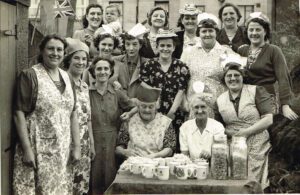
Coronation 1953. The white haired lady is my grandmother who lived in Berkeley Street, Eastville, Bristol. Notice the crossover aprons. They were very common though hardly attractive. And the ages of these women is quite surprising. I think my grandmother was only about seventy at the time. Most of the other women were younger, including the one with a baby. Some had no teeth. They were married but didn’t need to try, did they? Times have indeed changed. I wonder what they would have thought of us today; of botox, breast enhancement and trying to hold onto our youth? A different world indeed.
A New Doctor at the Orchard Cottage Hospital is set in the thirties. Back then and despite victory in securing the right to vote women were still second class citizens. They didn’t have the same rights either in education or the professions. In the thirties there were roughly only 2000 female doctors. For the most part the male establishment had an uphill path to climb.
However these were clever women and some fought their way through. One of these was Josephine Barnes, (1912-1999) the first president of the British Medical Association, an obstetrician and at the pinnacle of her profession.
Another was Emily Blackwell (1826-1910 and born in Bristol) who earned her qualification in the United States. Elizabeth Garrett Anderson (1836 – 1917) co founder of the London School of Medicine for Women.
They were the vanguard of equality in the medical profession, clever women that fought their way to the top and eventually earned the respect of their male colleagues and the profession in general.
In the first novel of The Orchard Hospital series, the female doctor, Frances Brakespeare, is forced to leave London for a small country town where old prejudices die hard and pre-NHS the local hospital is ran by landed gentry and philanthropists.
Previous to World War Two Bristol Airport was situated at Whitchurch (now a sprawling housing estate). It was mainly used for pleasure, air displays and flights to Ireland. As the threat of war intensified flights increased as did security. It was fenced off and eventually its grass runway was concreted over.
It’s not generally known but during WW2 Bristol airport was the only civilian airport still open and the reason is interesting. From Bristol – although not entirely out of range of bombing raids – it was capable of direct flights to neutral countries. One of them was Ireland but the other more important one was Lisbon in neutral Portugal.
It is documented that many celebrities and politicians flew from Bristol to Lisbon and then on to the USA and other places. You saw this happen in the film Casablanca starring Humphrey Bogart and Ingrid Bergman along with spies, spivs and intrigue.
The same happened at Bristol and although kept very hush hush the intelligence services kept a weather eye on the airport throughout the war. Not all on board were who their documentation said they were.
So there you have it – James Bond types at Bristol (Whitchurch) Airport.
After the war Bristol’s main airport was moved to Lulsgate south of the city off the A38.
Solidly built and for some the first time ever they’d had an indoor bathroom and running water. OK, only a cold water tap but a big improvement on the water pump outside in the communal yard. And a garden! Space to let the lawn grow tall or plant vegetables and flowers. Somewhere for the kids to run round. Imagine how that felt back in the thirties. Most have been sold off, two million in fact. Their like will never be seen again.
The heroine in book one of the Coronation Close series is over the moon when she acquires one. For the first time ever her family won’t be sharing their home with vermin, bugs and cockroaches. It’s just for them.
A lot of people ask me about research. Bear in mind that I grew up in the aftermath of WW2 so do have memories of bombsites, poor quality food, grey bread and make do and mend long after the war was over.
There were shortages on the home front and some of those shortages were reflected in the dressing table mirror. Women still wanted to look glamorous. The rumour of lipstick being in the shop brought a stampede of women all eager to enhance their looks. Ditto face powder, perfume or mascara – soot came in handy for making the latter. Lipstick doubled as rouge and sugar water made a pretty good setting lotion.
Shampoo was another thing that could be difficult to get hold of. For the most part, soap would have to do. It therefore followed that styles had to be kept simple like the one below featured in an advert for shampoo, something we now take very much for granted.